
India to provide free HPV vaccines. Who Should Get Vaccinated and Why It Matters ?
HPV Vaccine: Protecting Girls Today and Preventing Cancer Tomorrow
ONCOLOGY NEWS
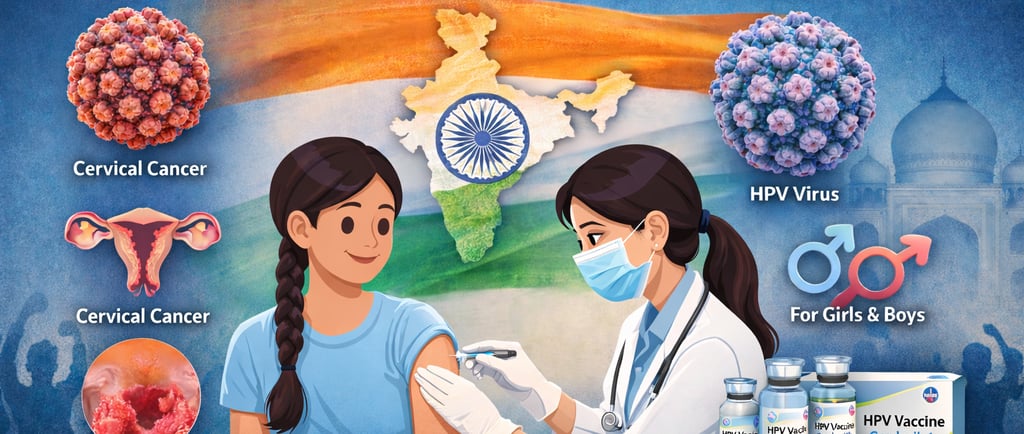
The Government of India is launching a nationwide 90-day HPV vaccination campaign starting March 2026, offering free HPV vaccines to 14-year-old girls at government health facilities. The goal is to reduce the burden of cervical cancer, which causes nearly 80,000 deaths annually in India.
The programme will primarily use Gardasil-4, a quadrivalent HPV vaccine that protects against four important HPV types, including HPV 16 and 18, which cause about 80–85% of cervical cancers in India.
Gardasil 4 vaccine manufactured by American pharmaceutical firm Merck & Co, which will be administered free of cost at government health facilities. A quadrivalent vaccine is a specific type of shot designed to stimulate an immune response against four different antigens, such as four distinct strains of a virus, providing broader protection. Understanding how a simple shot can prevent cancer is not just fascinating science; it is a life-saving bit of knowledge. HPV is a small, non-enveloped DNA virus. Unlike some viruses that are wrapped in a fatty layer, HPV is encased in a tough protein shell called a capsid.
What is HPV?
Human Papillomavirus (HPV) is a common virus that infects the skin and mucosal lining of the body, usually through skin-to-skin sexual contact. There are more than 200 HPV types, broadly classified into:
Low-risk types – may cause warts
High-risk types – may cause cancers
High-risk HPV types such as 16 and 18 produce proteins (E6 and E7) that disable the body’s natural tumour-suppressor mechanisms, allowing abnormal cells to develop into cancer over time.
Most infections clear naturally, but persistent infection over several years can lead to cervical cancer.
Why Vaccinate at Age 14?
HPV vaccination works best before exposure to the virus. HPV vaccine can be given as early as 9 years. Best works given between the age groups 9 - 14 years. Vaccinating adolescents ensures:
Stronger immune response
Higher antibody levels
Long-lasting protection
For this age group, even a single dose provides excellent protection, making large-scale vaccination feasible and cost-effective.
As the incidence of cervical cancers is high in India, than other HPV related cancers, this is most needed for all the females in the eligible age group.
Can Boys Benefit from HPV Vaccination?
Yes. HPV can also cause throat, head-and-neck, anal, and genital cancers in men.
Vaccinating boys helps:
Reduce HPV transmission
Provide herd immunity
Protect both men and women
Vaccines such as Gardasil-9 are available privately in India for both males and females up to 45 years of age.
Is the HPV Vaccine Safe?
HPV vaccines have been used worldwide for over a decade and have an excellent safety record.
Common side effects are mild and temporary:
Pain at injection site
Mild fever
Fatigue
With vaccines such as Gardasil-4 and India’s Cervavac, HPV vaccination represents one of the most effective methods to prevent cervical cancer.
The Bottom Line
HPV vaccination can prevent the majority of cervical cancers. India’s national vaccination drive is a major public-health step toward the future elimination of cervical cancer.
There is also growing scientific evidence and expanding indications for HPV vaccination in both men and women to prevent other HPV-related cancers, including oral (oropharyngeal), anal, penile, vulvar, and vaginal cancers. Increasing vaccination coverage across both genders is expected to significantly reduce the burden of these cancers in the coming decades.
Dr. Rajesh Natte
Clinical Oncologist
Dr Rajesh Natte
Sr Consultant
American oncology Institute
Nallagandla
Hyderabad
Phone
consult@drrajeshnatte.com
+91 9032648964
© 2025. All rights reserved.